How an Interactive Panel in Classrooms Improves Student Engagement
- Subha
- Sep 5, 2025
- 3 min read
Updated: Oct 1, 2025
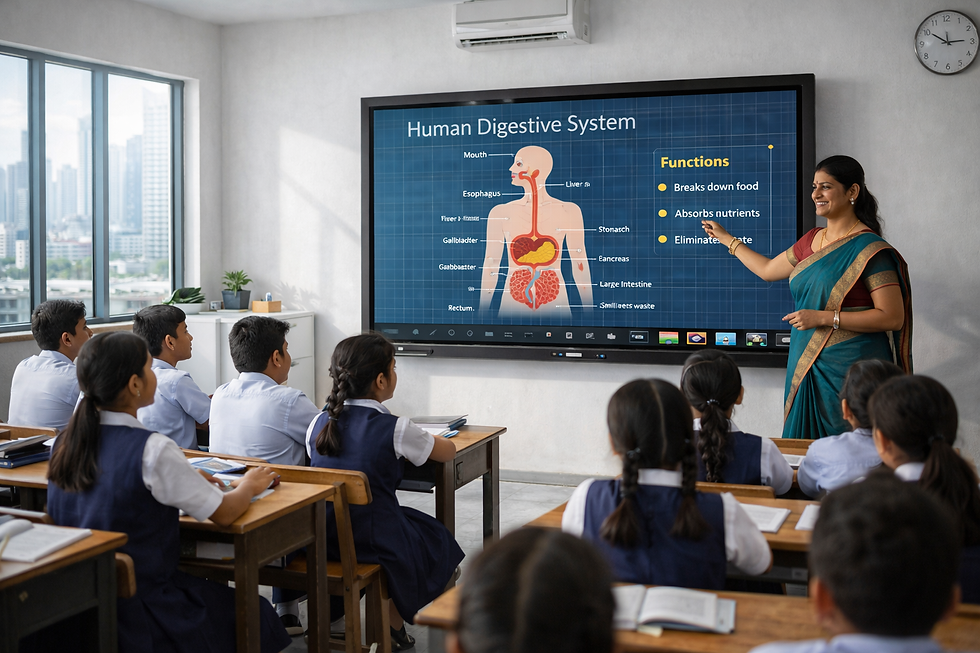
An interactive panel for school classrooms is more than just a display screen; it is a teaching tool that combines digital technology with active learning. These panels function like interactive touchscreens, allowing teachers to deliver lessons in an engaging way and students to interact directly with the content.
In modern education, maintaining students' attention and involvement is one of the greatest challenges. Traditional chalkboards and projectors often lead to passive learning, where students only listen and take notes. Interactive panels solve this by turning lessons into two-way experiences. Teachers can integrate videos, diagrams, quizzes, and real-time annotations, while students participate actively through touch, drawing, or problem-solving on the screen.
By creating a balance between visual learning and student participation, interactive panels highlight the benefits of interactive panel for students, helping classrooms become more dynamic and collaborative. This shift not only improves focus but also enhances interactive panel learning outcomes by encouraging active engagement and deeper understanding.
Key Ways Interactive Panels Improve Classroom Learning
1. Encourages Active Participation
Students can write, draw, or solve problems directly on the panel.
Multi-touch technology allows group activities where multiple learners interact at once.
2. Supports Visual and Multimedia Learning
Teachers can present videos, diagrams, and 3D models.
Complex topics become easier to understand through visual demonstration.
3. Makes Lessons Collaborative
Enables team-based activities like brainstorming or quizzes.
Students learn to share ideas and solve problems together on the screen.
4. Provides Instant Feedback
Teachers can run polls, quizzes, or practice exercises.
Results appear immediately, helping students learn from mistakes in real time.
5. Boosts Confidence and Motivation
Shy students are more likely to interact with technology than a chalkboard.
Gamified tools and interactive exercises make learning enjoyable.
6. Reduces Passive Learning
Instead of only listening to lectures, students become part of the lesson.
Active engagement improves attention span and retention. By aligning technology with pedagogy, the importance of interactive panel in education becomes clear these tools reshape how teachers teach and how students learn.

Comparison: Traditional Boards vs Interactive Panels
Aspect | Traditional Boards | Interactive Panels for Classrooms |
Student Participation | Limited, mostly teacher-led | High, multi-student interactivity |
Learning Style | Text-heavy, lecture-based | Visual, multimedia, interactive |
Feedback | Delayed, after class tests | Instant, through quizzes and polls |
Engagement Level | Passive, one-way communication | Active, collaborative learning |
How Interactive Flat Panels Help Students
Simplify Complex Topics: Visuals, diagrams, and multimedia make abstract concepts easier to understand.
Encourage Active Learning: Students can directly interact with lessons by writing, drawing, or solving problems on the panel.
Boost Collaboration: Group activities on the panel promote teamwork, discussion, and peer learning.
Improve Confidence: Shy students are more comfortable engaging with technology than speaking at the board.
Personalized Learning: Instant feedback allows students to track progress and improve quickly.
Enhance Creativity: Tools like stylus, color highlights, and interactive whiteboards let students express ideas more freely.
Support Different Learning Styles: Visual, auditory, and kinesthetic learners all benefit from diverse, multimedia content. These examples underline both the benefits of interactive panel for students and the measurable improvements in interactive panel learning outcomes when implemented effectively.
Conclusion
An interactive Flat panel for school classrooms goes beyond being just a display. It transforms teaching into an interactive, student-centered experience. By emphasizing the importance of interactive panel in education, schools can create environments where students stay motivated, attentive, and fully engaged.
FAQs
Q1. What is an interactive panel in a classroom?
It is a touchscreen display that allows teachers and students to write, draw, and interact with digital content, making lessons more interactive.
Q2. How does an interactive panel improve learning?
It improves learning by encouraging participation, supporting visual content, enabling collaboration, and giving instant feedback.
Q3. Why is student engagement important in schools?
Engaged students pay more attention, retain information better, and develop problem-solving and teamwork skills.
Q4. Are interactive panels suitable for all grade levels? Yes, they can be used in primary, secondary, and higher education classrooms for different subjects and teaching styles.